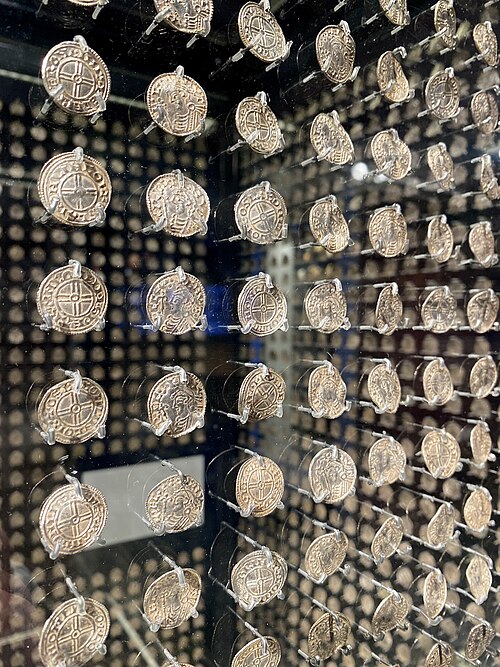
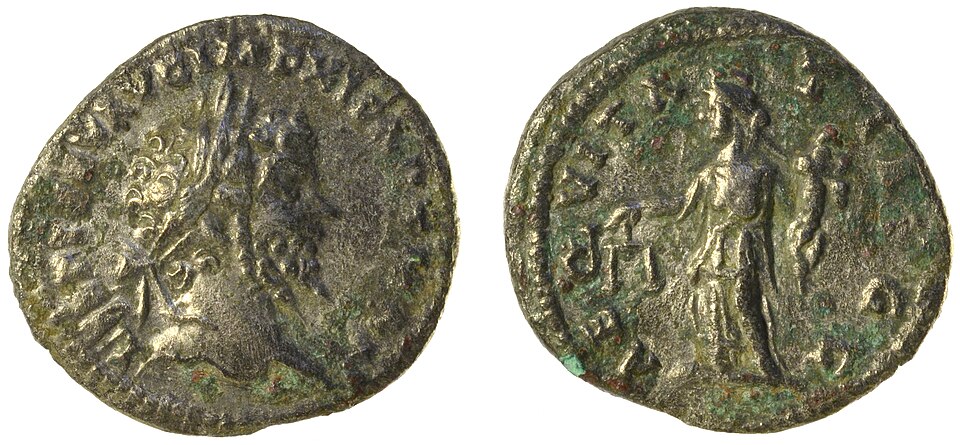
More than 5,000 silver pennies of Æthelred II and Cnut, buried in a lead parcel around 1035 and found at a detecting club rally near Buckingham in 2014. Valued at £1.35 million, the hoard is now in Aylesbury.
Just before Christmas 2014, Paul Coleman was one of the detectorists at a Weekend Wanderers club rally in fields south of Buckingham when he uncovered a sheet of lead, folded over and pinched closed at the ends. Inside it were silver pennies, packed together.
The county's Finds Liaison Officer, Ros Tyrrell of the Buckinghamshire County Museum, excavated the find the same day, working alongside the finder and the landowner. The coins were then driven to the British Museum for study.
There were more than 5,000 of them, struck in the names of two kings: Æthelred II, known as the Unready, who reigned until 1016, and Cnut, the Danish king who took England's throne that year and ruled until 1035. The newest coins date the burial to around 1035, the end of Cnut's reign. The museum describes it as the largest hoard of Anglo-Saxon silver coins found in Britain for more than 150 years.
The hoard was declared Treasure and valued at £1.35 million. That sum, the reward paid to the finder and the landowner, was what the Buckinghamshire County Museum in Aylesbury had to raise to keep the coins in the county. Its public appeal succeeded, and the hoard is on permanent display at what is now the Discover Bucks Museum.
Sources differ slightly on the exact count, between 5,248 and 5,252 coins.
First reported in 2014; recalled by The Times of India (via inkl, 20 September 2026). Written for Global Finds from that report, the Discover Bucks Museum, Buckinghamshire Culture and Ros Tyrrell's account of the excavation (Museum Crush, 2016). Photo: No Swan So Fine, Wikimedia Commons, CC BY-SA 4.0.
Those four are for England and Wales, where the Portable Antiquities Scheme records finds and the Treasure Act decides what must be reported.
Scotland runs its own system, and every find is reportable there — not only treasure. Treasure Trove Unit ›
The Republic of Ireland is different again, and severely so. Searching for archaeological objects without the Minister’s written consent is a criminal offence carrying fines or imprisonment, and the definition is broad enough to cover coins, buttons and buckles of almost any age. Do not assume British rules travel with you. The law, from the National Museum ›
Northern Ireland is stricter still. The Treasure Act applies and finds go to National Museums NI within fourteen days, but any searching that involves digging — metal detecting expressly included — needs a licence, and licences are only granted for archaeological projects. National Museums NI ›
This site covers discoveries from all over the world, and so does the variation in the law — from a recording scheme that thanks you, to a criminal offence. Wherever you are searching, find out what applies there before you go, not after.