How to read a metal detector’s signals
A guide by Rob · 24 September 2026
Every beep is information. The trick is knowing which part of it to trust: the tone, the number, or the way the signal behaves when you sweep over it again.
This guide is adapted from How to Read Metal Detector Signals by Tim Kennett of UK Metal Detectors (Kennett, 2026), and the illustrations are his, used with his kind permission.
What a signal actually is
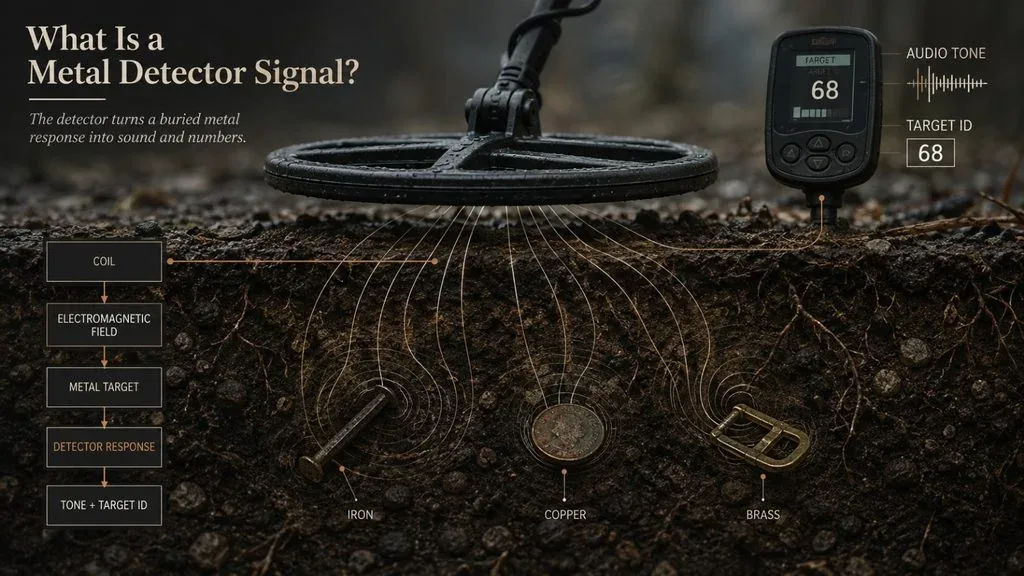
The coil sends a magnetic field into the ground. When that field meets metal, the metal disturbs it, and the detector turns the disturbance into two things you can use: a tone in your headphones and a target ID number on the screen. Different metals disturb the field in different ways — iron differently from silver, aluminium differently from copper — which is why they don’t all sound alike.
What catches people out is that the same object won’t always give the same signal. A coin reads differently when it’s deeper, when the ground is full of minerals, when it’s standing on its edge instead of lying flat, and even when you sweep faster or lift the coil higher on one pass than the last. A signal is a clue, not an identification.
Listening: the three kinds of tone
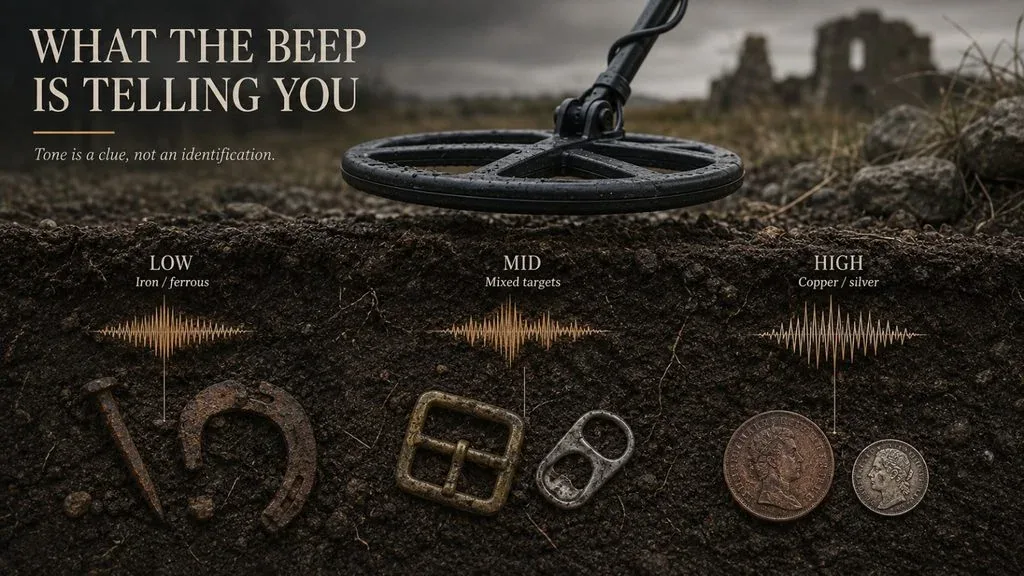
Most modern machines split their sounds into low, middle and high, and once you’re used to them you’ll often know what you think a target is before you look at the screen.
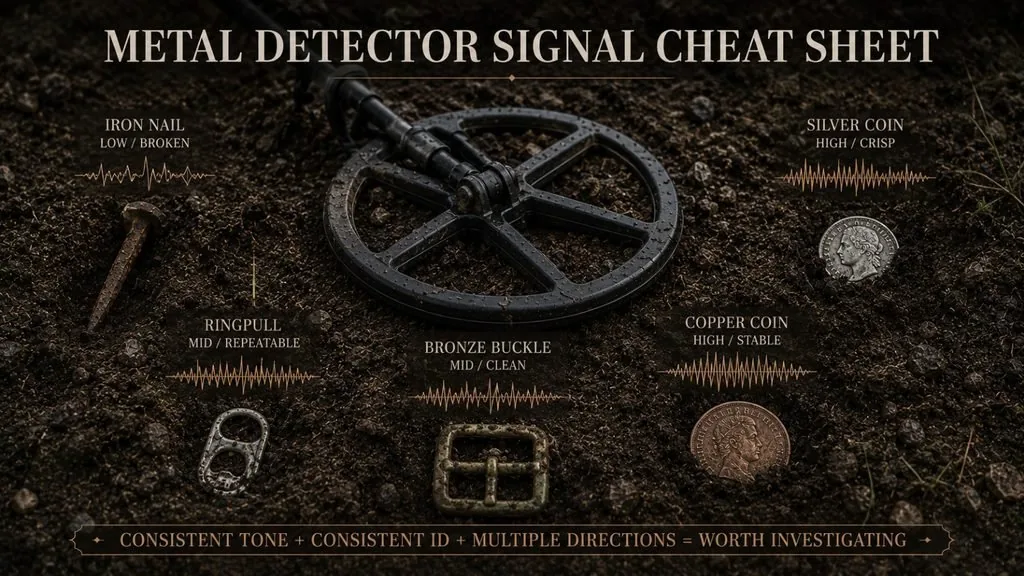
Low tones: iron. The grunt, the growl, the dull buzz. Nails, wire, horseshoes, bits of old farm machinery — anyone who has detected on British farmland knows how much of it there is. Most of it isn’t worth stopping for, but not all of it: some important finds are iron, and they sound exactly like the rubbish.
Mid tones: the awkward middle. Brass, bronze, lead, aluminium and ring pulls all live here, and so does gold. A small gold ring can sound just like a ring pull. Dig nothing but high tones and you will walk past gold.
High tones: silver and copper. The sound everyone is waiting for. But the quality of a high tone matters as much as its pitch: a clean, crisp note that comes back every time you cross the spot is far more promising than a high blip that appears once and vanishes.
Hearing the iron on purpose. Many detectors can play iron as a low tone instead of silencing it altogether. That sounds like more noise, but it’s the opposite: when a coin lies next to a nail you hear the grunt and the good tone together, instead of a muddle you’d probably have walked away from. On old farmland and around field gateways it’s worth having on.
Reading the number
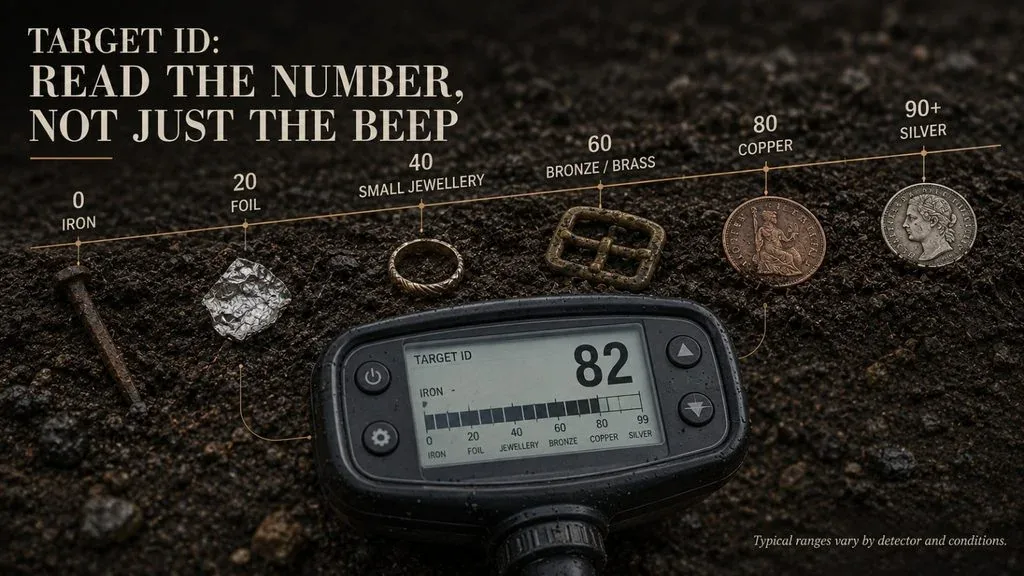
The target ID tells you roughly where a target sits on the machine’s conductivity scale: low for iron and poor conductors, high for silver and copper. Many detectors use a 0 to 99 scale, but not all of them — the Minelab X‑Terra Elite runs from −19 to 99, with iron in the negative numbers.
As a rough guide on a generic 0 to 99 scale (Kennett, 2026):
| Target | Typical ID (generic 0–99) |
|---|---|
| Iron nails and ferrous rubbish | 0–15 |
| Foil and thin lead | 15–25 |
| Small gold jewellery and ring pulls | 28–45 |
| Bronze and brass | 45–65 |
| Large copper coins and bronze | 65–85 |
| Victorian and Georgian copper pennies | 75–85 |
| Silver coins, hammered and milled | 80–95 see below |
One row in that table needs a warning: hammered silver. Hammered coins are thin, often small and sometimes clipped, and on many modern detectors they read far lower than the thick milled silver they share a row with. On my X‑Terra Elite a hammered penny usually reads somewhere in the high 20s to low 40s, and a cut or clipped fraction lower still — right among the foil and ring pulls. A chart that puts all silver at the top of the scale is exactly how hammered silver gets left in the ground.
Your own machine’s figures will be different again, and that is the point. For one real example, my own table for the X‑Terra Elite puts several of these targets in quite different places. Every machine speaks its own dialect.
Three things push the number around:
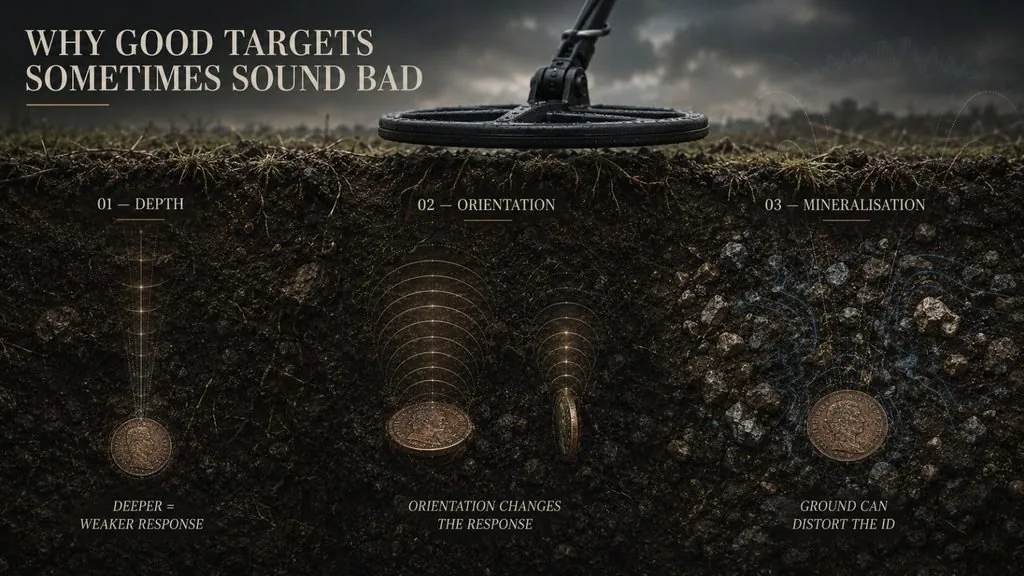
- Depth. A deep coin gives a weaker return, and the number often drops and wanders. If your discrimination only accepts high numbers, a deep good coin is exactly the one you’ll never hear.
- Neighbours. Two objects close together — typically a nail beside a coin — can make the number jump between low and high on every pass. Beginners take that as proof of rubbish. Often it’s iron hiding something better.
- Ground, which is covered further down.
The best single test: does it repeat?
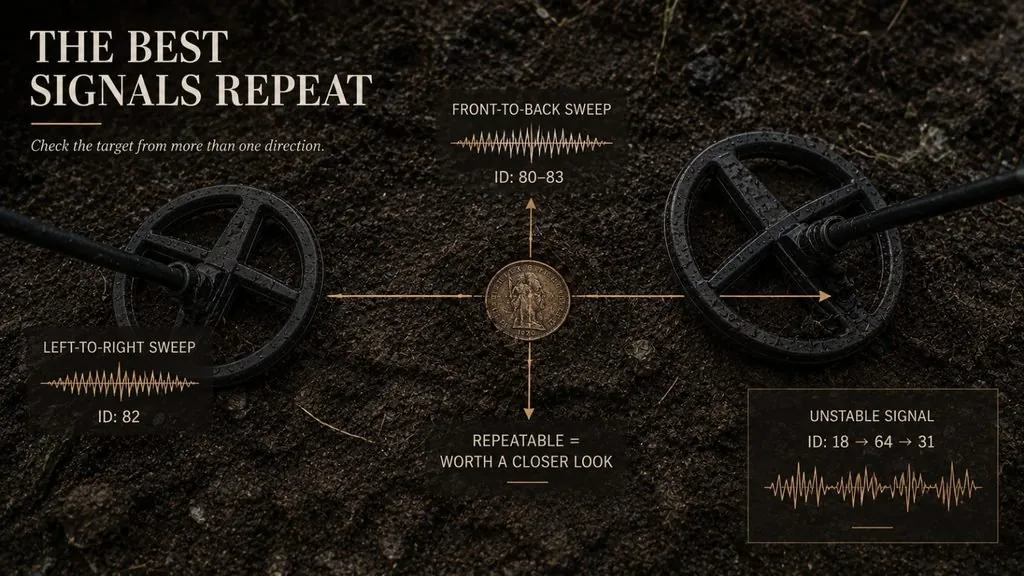
A real object in the ground usually gives the same answer twice. So when something catches your ear, stop walking and work the spot:
- Sweep across it several times from the same direction. Does the tone come back in the same place? Does the number stay in roughly the same range?
- Turn through about 90 degrees and sweep across it again.
- If it’s still there, with a similar tone and number, it’s very likely a genuine target.
A signal that vanishes when you change direction is usually iron lying at an angle, a tiny fragment, or the ground itself. A signal that’s broken rather than gone — scratchy, patchy, unsure of itself — has more possible explanations: something very small, badly corroded, very deep, or two objects together. None of those is a guaranteed good find, but none is a reason to walk away without a second listen, either.
Why a good target can sound bad
Mineralised ground. Some soils answer the detector back: minerals in the ground produce a response of their own, which makes the machine noisier and nudges the numbers. Cornwall, Wales, parts of the Midlands and the North are known for it, and wet beach sand is its own problem entirely (Kennett, 2026). Getting the ground balance right, so that the detector learns to ignore the soil, makes everything else easier to judge.
Depth. Deeper means quieter and less steady. A shallow Victorian penny shouts; a deep one mumbles. On a site with a history of older finds, the mumbles deserve patience.
Angle. A coin lying flat gives a much bigger signal than the same coin standing on its edge. It’s one reason a field that has “been done” can still produce finds when you search it slowly and from a different direction.
From signal to find
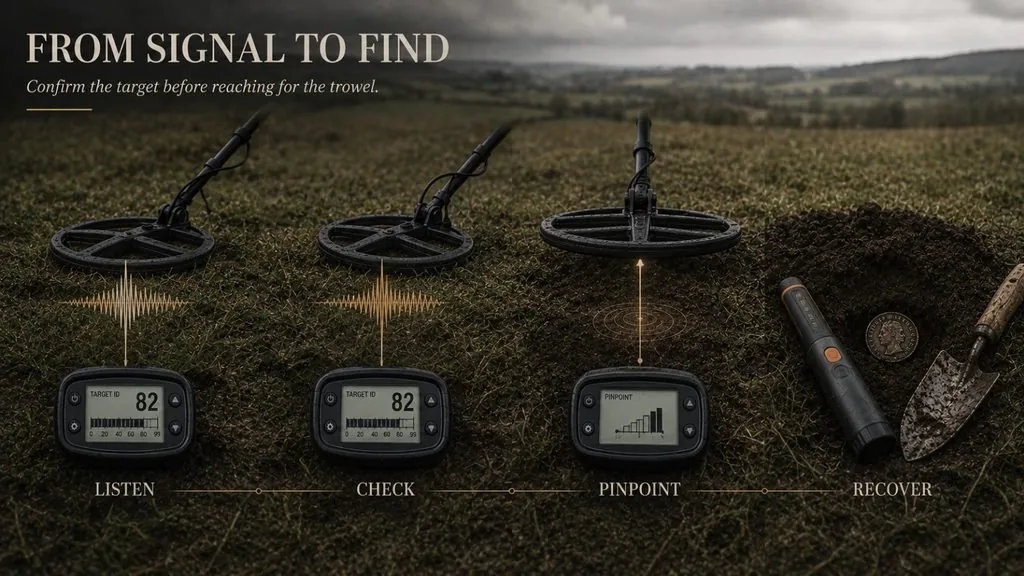
Once a signal has passed the repeat test:
- Confirm it. Sweep from two directions at right angles, slowly. Slowing down alone often clears up a confusing signal.
- Pinpoint it. Most detectors have a pinpoint mode that shows where the signal is strongest. Knowing the centre means a smaller, neater hole.
- Use a hand pinpointer to find the object in the hole or the loose soil, rather than crumbling the spoil through your fingers.
A small hole is also a tidy hole: easier to backfill, easier on the crop or the turf, and part of why farmers keep saying yes.
Learn your own machine
No chart will teach you your detector as fast as your detector will. Two ways to speed it up:
A test garden. Bury a handful of known objects at the same depth — say a post-1947 sixpence, a pre-decimal penny, a £1 coin, a ring pull, a piece of foil and an iron nail — and sweep over each one slowly, noting the tone and number. Now you know what your machine says in your ground, not what a chart says about someone else’s. If you use the coins from my X‑Terra Elite table, you can compare your numbers with mine.
A dig log. For every target you dig, note the number, the tone, roughly how deep it was, and what it turned out to be. After a few outings patterns appear: the slightly broken mid tone that keeps turning out to be buttons, the number that’s always foil.
Quick reference
| What you hear | What it usually means | What to do |
|---|---|---|
| Steady low grunt | Iron | Listen for a better tone mixed in; otherwise move on |
| Low grunt from one direction only | Iron lying at an angle | Move on |
| Steady mid tone that repeats | Brass, bronze, a ring pull — or gold | Dig it: this is where gold hides |
| Mid tone flicking between low and high | Iron next to something better | Dig carefully |
| Clean high tone from both directions | Silver or a large copper coin | Dig |
| High tone, slightly broken | A deep or corroded coin, or two targets | Slow down and check again |
| Gone on the second pass | Ground noise or a tiny fragment | Move on |
| Number jumps on every sweep | A mixed signal, or iron masking | Decide on the tone, not the number |
| Same tone, same number, both directions | A genuine buried target | Dig with confidence |
Every line in that table comes back to the same thing: one loud beep proves nothing; a signal that repeats is worth your time.
Reference
- Kennett, T. (2026) How to read metal detector signals: what every beep and number actually means. UK Metal Detectors, 3 September. Available at: https://uk-metal-detectors.co.uk/how-to-read-metal-detector-signals (Accessed: 24 September 2026).
Illustrations © UK Metal Detectors, reproduced with permission.